Introduction
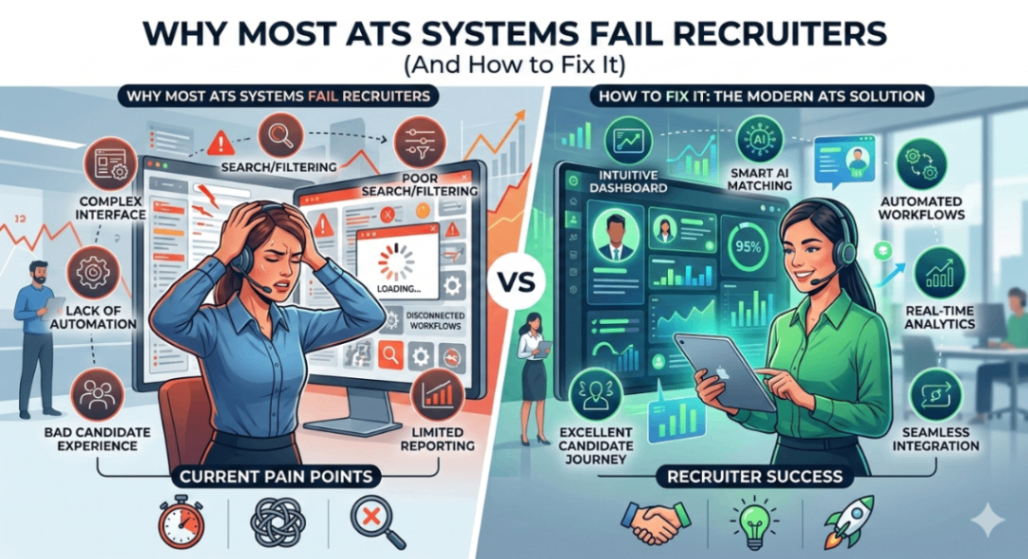
Applicant Tracking Systems (ATS) were designed to bring structure and organization to recruitment. They promised centralized resume databases, workflow tracking, and simplified hiring processes. However, despite widespread adoption, many recruiters feel frustrated rather than empowered by their ATS.
The problem is not that ATS technology is ineffective — it is that most traditional systems were built for data storage, not recruiter performance optimization. In today’s competitive hiring environment, recruiters need intelligence, automation, and analytics — not just tracking tools.
Understanding why most ATS systems fail recruiters is the first step toward fixing the problem.
Our Recruitment Technology Services
Modern recruitment requires systems that support speed, conversion optimization, and performance visibility. Many organizations struggle because their ATS lacks flexibility, automation, and analytics capabilities.
Our recruitment technology services help organizations:
-
Audit existing ATS workflows
-
Identify inefficiencies and recruiter bottlenecks
-
Implement automation-driven recruitment systems
-
Enable recruiter performance dashboards
-
Integrate ATS with CRM, job boards, and communication tools
-
Design intelligent candidate scoring frameworks
With the right technology architecture, recruitment platforms become performance enablers rather than administrative burdens.
Benefits for Businesses
When ATS limitations are resolved, organizations experience measurable improvements:
Higher Recruiter Productivity – Less manual work, more strategic hiring
Improved Candidate Experience – Faster responses and structured communication
Better Conversion Ratios – Optimized submission-to-interview performance
Reduced Time-to-Hire – Elimination of workflow bottlenecks
Stronger Data Visibility – Real-time recruitment performance insights
A well-optimized recruitment platform directly impacts hiring outcomes and revenue growth.
Key Insights: Why Most ATS Systems Fail Recruiters
1. Designed for Compliance, Not Performance
Many ATS systems were originally built for HR documentation and compliance tracking, not recruiter efficiency. As a result, they focus more on record-keeping than hiring optimization.
Fix: Implement performance-driven dashboards and recruiter KPI tracking.
2. Lack of Automation
Manual tasks such as resume screening, interview coordination, and follow-ups consume recruiter time unnecessarily.
Fix: Integrate automation tools for shortlisting, scheduling, and communication workflows.
3. No Intelligent Candidate Ranking
Traditional ATS platforms rely on basic keyword matching, leading to irrelevant candidate recommendations.
Fix: Introduce dynamic scoring systems based on job match, historical performance, and recruiter insights.
4. Poor Visibility Into Conversion Metrics
Recruiters often lack visibility into critical performance metrics such as:
-
Submission-to-interview ratio
-
Interview-to-offer conversion
-
Offer-to-joining success rate
Without analytics, performance cannot be optimized.
Fix: Enable structured conversion tracking and real-time analytics dashboards.
5. Workflow Complexity and Poor User Experience
Overly complicated systems reduce adoption and increase recruiter frustration.
Fix: Simplify workflows and prioritize intuitive UI design.
6. Limited Integration Capabilities
Many ATS platforms operate in isolation without seamless integration with:
-
Job portals
-
Email systems
-
Calendar tools
-
CRM platforms
This leads to scattered communication and duplicated work.
Fix: Implement integrated recruitment ecosystems.
7. Static Reporting Instead of Predictive Insights
Traditional ATS systems tell recruiters what happened — not what will happen next.
Fix: Introduce predictive analytics for hiring outcomes and offer acceptance forecasting.
How to Fix ATS Failure: Moving Toward Recruitment Intelligence
To overcome ATS limitations, organizations must transition from passive tracking systems to intelligent recruitment platforms.
Key steps include:
-
Implementing automation across hiring stages
-
Tracking recruiter performance metrics
-
Using analytics to optimize candidate submissions
-
Reducing manual coordination
-
Leveraging data to improve decision-making
When recruitment systems become insight-driven, recruiters shift from administrative operators to strategic hiring advisors.
How We Help
We assist organizations in transforming underperforming ATS platforms into optimized recruitment intelligence systems by:
-
Conducting workflow audits
-
Identifying inefficiencies and process gaps
-
Designing automation frameworks
-
Building recruiter performance dashboards
-
Aligning hiring KPIs with measurable data insights
Our objective is simple: empower recruiters with systems that improve hiring speed, accuracy, and success rates.
Conclusion
Most ATS systems fail recruiters not because the technology is broken, but because it was designed for a different era of hiring.
Modern recruitment demands intelligence, automation, and measurable performance optimization. Organizations that upgrade from static tracking systems to intelligent recruitment platforms gain competitive advantage, faster hiring cycles, and improved placement success.
An ATS should not slow recruiters down — it should make them unstoppable.