Introduction
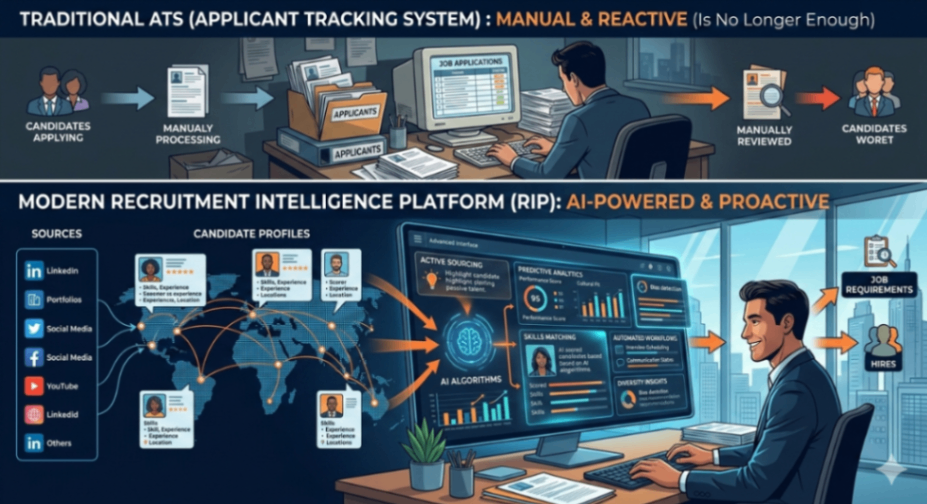
Recruitment has evolved from manual resume screening to digital applicant tracking systems (ATS). While traditional ATS platforms brought structure to hiring workflows, they were primarily designed to store data, track applications, and manage hiring stages.
Today’s hiring environment is far more competitive and data-driven. Organizations need insights, predictive analytics, performance optimization, and automation — not just tracking. This shift has led to the rise of the Recruitment Intelligence Platform .
Unlike a conventional ATS, a Recruitment Intelligence Platform leverages analytics, automation, and behavioral data to improve hiring outcomes continuously. It doesn’t just record recruitment activity — it learns from it.
Our Recruitment Technology Services
Modern recruitment intelligence requires expertise across technology, analytics, and hiring strategy. Many organizations struggle not because tools are unavailable, but because systems are not properly configured, integrated, or optimized.
Our recruitment technology services help businesses:
-
Design intelligent recruitment workflows
-
Implement advanced analytics within hiring systems
-
Integrate ATS platforms with CRM, job boards, and automation tools
-
Build recruiter performance dashboards
-
Enable predictive hiring insights
-
Optimize data architecture for long-term scalability
With the right technology foundation and expertise, recruitment systems transition from passive databases to active intelligence engines.
Benefits for Businesses
Adopting a Recruitment Intelligence Platform delivers measurable business impact:
Data-Driven Hiring Decisions – Move beyond intuition to performance-backed insights
Improved Time-to-Hire – Identify bottlenecks and optimize recruitment cycles
Higher Placement Success Rates – Use historical performance patterns to improve matching
Recruiter Performance Visibility – Track conversion ratios and productivity metrics
Better Client Retention (for Agencies) – Deliver consistent, data-supported hiring outcomes
Instead of simply tracking applicants, organizations gain strategic control over hiring performance.
Key Insights: Recruitment Intelligence Platform vs Traditional ATS
1. Tracking vs Learning
Traditional ATS:
Primarily stores resumes, tracks stages, and generates reports.
Recruitment Intelligence Platform:
Analyzes historical placements, recruiter behavior, and candidate performance to improve future outcomes.
2. Static Workflow vs Dynamic Optimization
Traditional ATS follows predefined workflows.
Recruitment Intelligence Platforms identify patterns such as:
-
Which recruiter performs best for certain roles
-
Which candidate profiles convert faster
-
Which clients have longer hiring cycles
-
Where drop-offs occur in the funnel
This enables continuous optimization rather than static process management.
3. Basic Reporting vs Predictive Analytics
Traditional ATS provides descriptive reporting (what happened).
Recruitment Intelligence Platforms provide predictive insights (what is likely to happen next), including:
-
Offer acceptance probability
-
Submission-to-interview conversion likelihood
-
Role fill-time estimation
-
Recruiter success forecasting
4. Resume Database vs Revenue Engine
In a traditional ATS, resumes sit in storage.
In a Recruitment Intelligence Platform, candidate data becomes a strategic asset used for:
-
Smart ranking
-
Automated shortlisting
-
Cross-client opportunity mapping
-
Duplicate prevention
-
Intelligent resubmission strategies
5. Manual Oversight vs Automated Decision Support
Traditional ATS requires manual analysis by managers.
Recruitment Intelligence Platforms automate insights, providing real-time dashboards and alerts to support faster decision-making.
How We Help
Transitioning from a traditional ATS to a Recruitment Intelligence Platform requires structured planning and technical execution. We support organizations by:
-
Auditing existing recruitment systems
-
Identifying data gaps and inefficiencies
-
Designing analytics and scoring frameworks
-
Implementing recruiter performance tracking
-
Building scalable recruitment data architecture
-
Aligning technology with measurable hiring KPIs
Our focus is not just system implementation — but enabling measurable recruitment performance improvement.
Conclusion
Traditional ATS platforms brought structure to recruitment. However, in today’s competitive talent market, structure alone is insufficient.
Organizations require intelligence — systems that learn from historical hiring data, optimize recruiter performance, and predict outcomes before they happen.
A Recruitment Intelligence Platform transforms hiring from a transactional process into a strategic growth function. As hiring volumes increase and competition intensifies, intelligent recruitment technology is no longer optional — it is essential.