Introduction
In recruitment, success is often measured by the number of placements or the speed of hiring. However, one of the most important and often overlooked metrics is the Submission-to-Interview Ratio.
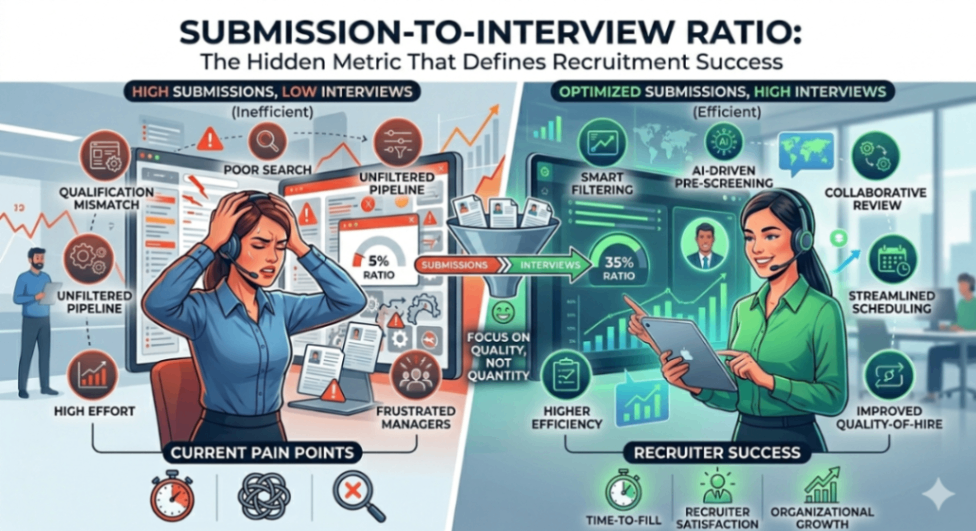
This metric measures how many candidate submissions actually convert into interviews. A strong ratio indicates that recruiters are identifying high-quality candidates who closely match job requirements. A poor ratio, on the other hand, suggests inefficiencies in sourcing, screening, or candidate-job alignment.
For recruitment agencies and talent acquisition teams, understanding and optimizing this ratio can significantly improve hiring efficiency, client satisfaction, and placement success.
Our Recruitment Technology Services
Improving submission-to-interview ratios requires more than recruiter effort — it requires the right technology and data visibility.
Our recruitment technology services help organizations:
-
Track recruiter performance metrics
-
Analyze submission-to-interview conversion rates
-
Implement intelligent applicant tracking systems (ATS)
-
Build recruitment analytics dashboards
-
Optimize candidate sourcing strategies
-
Improve candidate-job matching accuracy
With the right recruitment intelligence tools, organizations can transform raw recruitment data into actionable insights.
Benefits for Businesses
Monitoring and optimizing the submission-to-interview ratio delivers multiple business advantages:
Improved Candidate Quality – Better alignment between candidate profiles and job requirements
Higher Client Satisfaction – Clients receive stronger, more relevant candidate submissions
Increased Recruiter Productivity – Recruiters focus on quality rather than quantity
Faster Hiring Cycles – Fewer rejected submissions reduce delays
Better Revenue Outcomes for Agencies – Higher conversion rates increase placements
A well-optimized submission-to-interview ratio is a strong indicator of recruitment efficiency.
Key Insights: Understanding the Submission-to-Interview Ratio
1. What Is the Submission-to-Interview Ratio?
The submission-to-interview ratio measures how many submitted candidates get selected for interviews.
Example:
If a recruiter submits 10 candidates and 4 are invited for interviews, the ratio is:
10:4 or 2.5:1
A lower ratio generally indicates higher submission quality.
2. Why This Metric Is Often Overlooked
Many recruitment teams focus on activity metrics such as:
-
Number of candidates sourced
-
Number of resumes submitted
-
Number of interviews scheduled
However, these metrics do not reflect submission quality. The submission-to-interview ratio reveals how effectively recruiters match candidates to job requirements.
3. What a Healthy Ratio Looks Like
While ratios vary across industries, common benchmarks include:
-
Excellent: 2:1 to 3:1
-
Average: 4:1 to 6:1
-
Poor: Above 7:1
High ratios often indicate poor candidate targeting or insufficient screening.
4. Factors That Affect Submission-to-Interview Ratios
Several factors influence this metric:
Job Requirement Clarity
Incomplete or unclear job descriptions reduce candidate matching accuracy.
Candidate Screening Quality
Insufficient evaluation of candidate skills or experience can lead to irrelevant submissions.
Client Expectations
Misalignment between recruiter interpretation and client expectations can lower interview conversion rates.
Recruiter Experience
Experienced recruiters generally achieve better submission ratios due to stronger candidate evaluation skills.
5. How Recruitment Analytics Improves This Metric
Modern recruitment platforms provide data-driven insights that help improve submission-to-interview ratios.
These systems can:
-
Track recruiter-level conversion rates
-
Identify high-performing candidate sources
-
Highlight patterns in successful placements
-
Detect inefficiencies in the hiring funnel
Data visibility allows recruitment teams to continuously refine their strategies.
How We Help
Optimizing recruitment metrics requires structured analysis and technology support. We help organizations improve their submission-to-interview ratios by:
-
Implementing recruitment analytics dashboards
-
Tracking recruiter conversion metrics
-
Improving candidate-job matching algorithms
-
Designing performance monitoring frameworks
-
Aligning recruiter KPIs with hiring outcomes
Our goal is to enable recruitment teams to focus on precision hiring rather than high-volume submissions.
Conclusion
The submission-to-interview ratio is one of the most powerful indicators of recruitment performance. While many organizations focus on hiring speed or total placements, this hidden metric reveals the true effectiveness of candidate selection.
By tracking and optimizing this ratio, recruitment teams can improve candidate quality, accelerate hiring processes, and strengthen client relationships.
In modern recruitment environments, success is no longer defined by the number of resumes submitted — it is defined by how many of those submissions actually convert into meaningful hiring opportunities.