Introduction
Time-to-hire is one of the most critical recruitment performance metrics. The longer a position remains open, the higher the revenue loss, productivity gap, and candidate dropout risk. In competitive hiring markets, slow recruitment processes directly impact business growth.
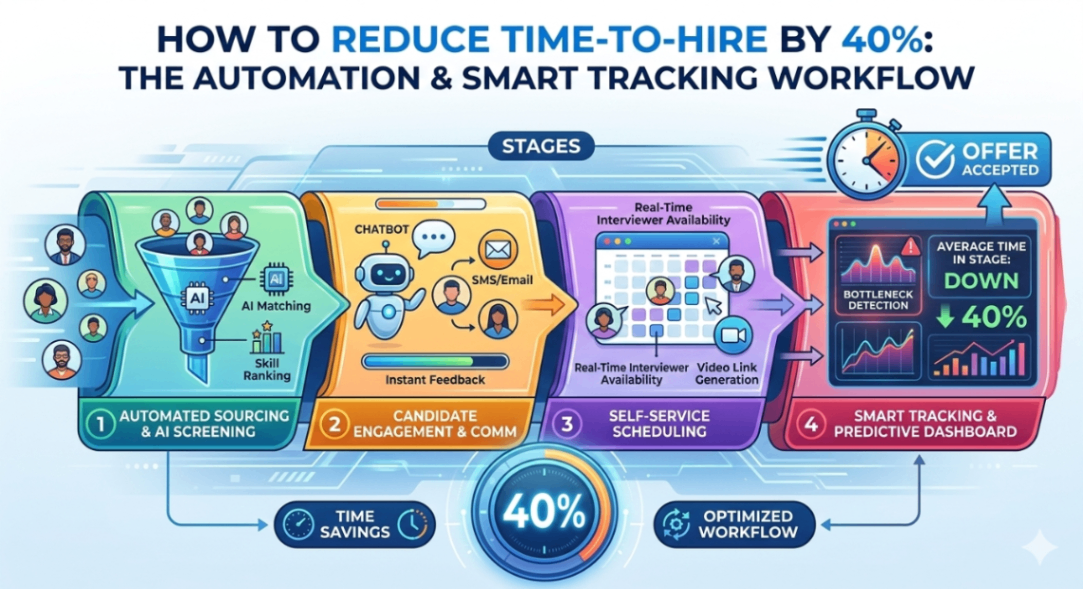
Many organizations still rely on manual coordination, spreadsheet tracking, and disconnected communication channels — leading to unnecessary delays. By implementing recruitment automation and smart tracking systems, companies can reduce time-to-hire by up to 40% while improving candidate quality and recruiter efficiency.
Our Recruitment Technology Services
Reducing time-to-hire requires more than faster resume screening. It demands structured workflows, data visibility, and performance analytics.
Our recruitment technology services help organizations:
-
Implement intelligent applicant tracking systems (ATS)
-
Automate candidate communication workflows
-
Enable recruiter performance tracking
-
Build real-time hiring dashboards
-
Optimize submission-to-interview conversion rates
-
Identify bottlenecks across hiring stages
With the right automation framework, recruitment becomes measurable, predictable, and scalable.
Benefits for Businesses
Organizations that leverage automation and smart tracking experience measurable improvements:
40% Faster Hiring Cycles – Reduced delays between stages
Improved Candidate Experience – Faster communication and scheduling
Higher Recruiter Productivity – Reduced manual coordination work
Better Conversion Ratios – Optimized submission-to-interview tracking
Lower Cost-per-Hire – Fewer process inefficiencies
Automation does not replace recruiters — it enhances their effectiveness.
Key Insights: How to Reduce Time-to-Hire Using Automation
1. Automate Resume Screening and Shortlisting
Manual resume review consumes significant recruiter time. Intelligent filtering and keyword-based shortlisting accelerate the initial screening process.
Smart systems can:
-
Rank candidates based on job description match
-
Auto-filter unqualified applications
-
Highlight high-potential profiles
2. Implement Stage-Based Workflow Tracking
Many delays occur because hiring stages are not clearly monitored.
Smart tracking enables:
-
Real-time visibility into each recruitment stage
-
Automatic status updates
-
Identification of bottlenecks (e.g., delayed interview feedback)
This prevents candidates from getting stuck in the pipeline.
3. Automate Interview Scheduling
Back-and-forth communication between recruiters, candidates, and hiring managers wastes valuable time.
Automation tools allow:
-
Calendar synchronization
-
Auto-generated interview invites
-
Reminders to reduce no-shows
This alone can significantly cut hiring cycle duration.
4. Track Submission-to-Interview Conversion Ratios
Recruiters often submit multiple candidates without analyzing performance patterns.
Smart tracking helps:
-
Identify which profiles convert faster
-
Detect underperforming submissions
-
Improve targeting strategies
Higher conversion rates naturally reduce hiring time.
5. Use Real-Time Hiring Dashboards
Without centralized data, decision-making slows down.
Advanced recruitment dashboards provide:
-
Time-to-hire analytics
-
Recruiter performance metrics
-
Stage-wise aging reports
-
Offer acceptance tracking
Data visibility accelerates managerial decision-making.
6. Reduce Manual Follow-Ups Through Automated Communication
Candidates frequently drop out due to lack of updates.
Automation enables:
-
Status update emails
-
Interview reminders
-
Offer follow-up sequences
This keeps candidates engaged and shortens closing cycles.
How We Help
Reducing time-to-hire requires structured implementation, not just tool adoption. We support organizations by:
-
Auditing existing hiring workflows
-
Identifying delay points in recruitment stages
-
Implementing automation frameworks
-
Designing recruiter performance dashboards
-
Optimizing submission strategies
-
Aligning hiring KPIs with measurable analytics
Our goal is to transform recruitment from reactive coordination to optimized execution.
Conclusion
Time-to-hire is not reduced by working harder — it is reduced by working smarter.
Organizations that implement automation and smart recruitment tracking gain measurable speed, improved hiring quality, and stronger candidate engagement. As hiring demands increase, intelligent process optimization becomes essential for competitive advantage.
Reducing time-to-hire by 40% is not aspirational — it is achievable with the right recruitment intelligence strategy.